.svg)

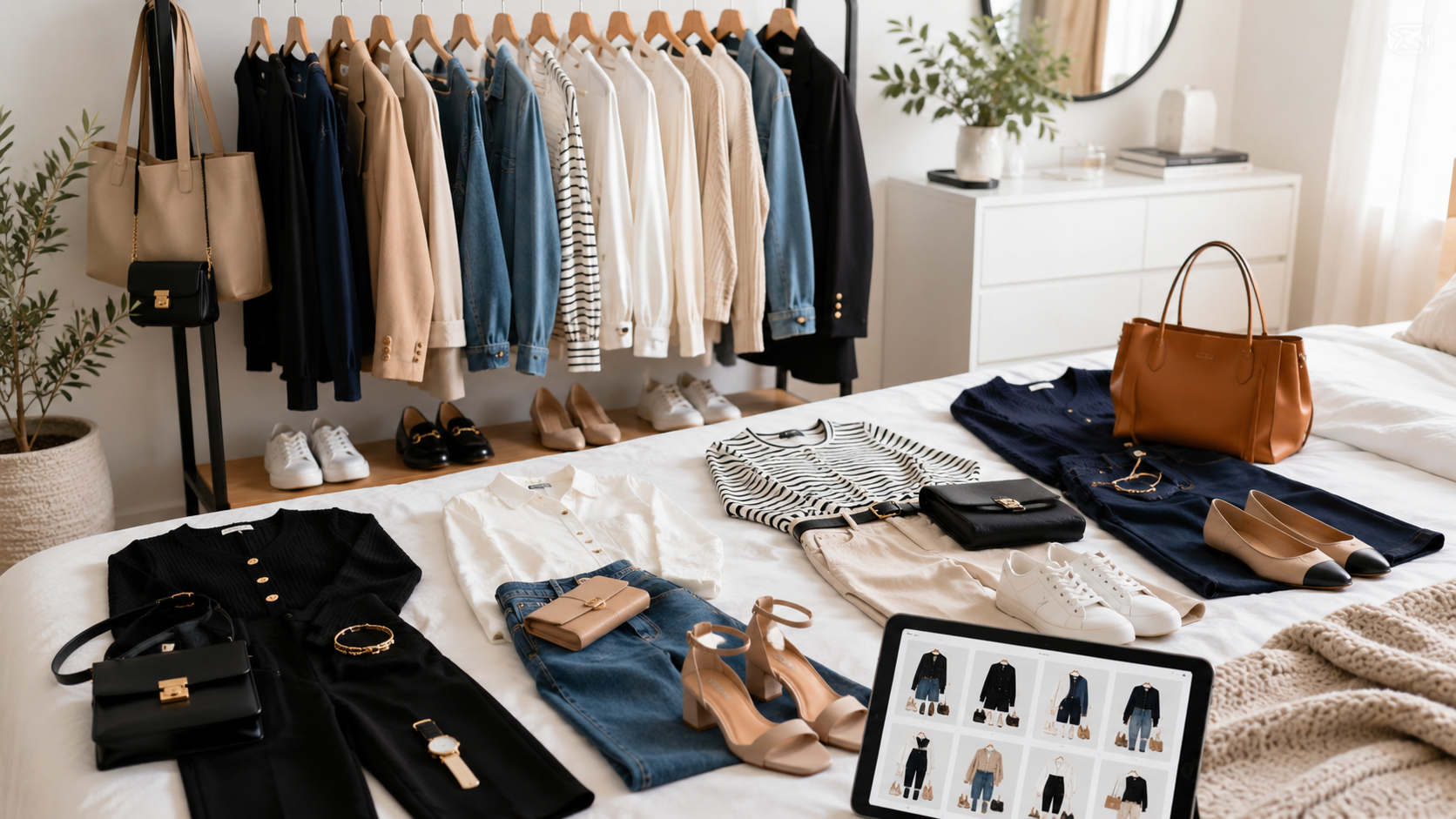
There is a very specific moment near the end of summer when your wardrobe starts acting suspicious.
The clothes that worked in June feel tired. Your calendar starts filling up again. Work, school, errands, appointments, meetings, dinners, drop-offs, commutes, and “wait, how is it already September?” all return with unnecessary confidence.
And suddenly you feel the urge to shop.
Not gently. Not thoughtfully. More like: “I need a new life, and apparently it starts with trousers.”
Before you buy anything for fall, pause.
You may not need a full wardrobe refresh. You may need a back-to-routine wardrobe reset: a simple way to turn the clothes you already own into outfits that work for your real life again.
The best place to start? Build 10 outfits before you buy anything new.
Quick answer: before shopping for fall, create 10 outfits from clothes you already own
A back-to-routine wardrobe reset helps you figure out what you can actually wear before you spend money on new clothes.
Start by building 10 outfits for your real weekly routine:
- Two work or meeting outfits
- Two casual errand outfits
- Two dinner or social outfits
- Two hot-to-cool transition outfits
- One comfortable travel or busy-day outfit
- One confidence outfit for when you need to feel pulled together fast
This gives you a working outfit bank for the season ahead. It also shows you what is truly missing from your wardrobe.
Because the goal is not to buy more fall clothes.
The goal is to stop buying around the clothes you already forgot how to wear.
Why you should build outfits before buying fall clothes
Fall shopping is tempting because it arrives with structure. Summer can feel loose and repetitive, but fall promises polish, layers, boots, denim, jackets, sweaters, routines, and the illusion that this year you will become someone who always knows where her keys are.
Beautiful dream. Suspicious, but beautiful.
The problem is that shopping first often creates more wardrobe confusion, not less.
You buy a blazer, but you do not have the right top for it. You buy trousers, but they only work with one pair of shoes. You buy a sweater in a great color, then realize it goes with nothing you actually wear. You buy “the perfect fall dress,” which turns out to be perfect for a version of your life that requires fewer emails and more apple orchards.
Building outfits first prevents that.
When you create outfits from your existing wardrobe, you can see:
- What still fits your life
- What pieces you forgot you owned
- What items are actually useful
- What you keep avoiding
- What combinations already work
- What gaps are real
- What gaps are just boredom wearing a trench coat
A wardrobe reset gives you evidence before you shop.
Very annoying. Very effective.
What is a back-to-routine wardrobe reset?
A back-to-routine wardrobe reset is a quick seasonal check-in that helps your wardrobe match your actual schedule again.
It is not a full closet cleanout. It is not a dramatic pile-everything-on-the-bed situation unless you enjoy chaos as a weekend activity. It is not about starting over.
It is about asking:
- What does my routine look like now?
- What do I need to get dressed for most often?
- Which clothes make those situations easier?
- Which clothes are sitting there doing unpaid decorative labor?
- What outfits can I create before buying anything else?
Think of it as a practical bridge between late summer and fall.
You are not putting away every summer item. You are not buying a whole new fall wardrobe. You are building outfits that work for the transition.
Step 1: List your real routine
Before touching your clothes, look at your actual life.
Not your fantasy life. Not your Pinterest life. Not the life where you casually attend gallery openings in a silk trench coat on a Tuesday.
Your real one.
Write down the situations you dress for most often:
- Office or meetings
- Work from home
- School drop-off or pickup
- Errands
- Appointments
- Commute
- Travel days
- Casual dinners
- Date nights
- Weekend plans
- Events
- Exercise or walks
- Indoor-outdoor temperature swings
- Days when you need to look polished fast
Now choose the top five situations that happen most often.
Your 10 outfits should support those first.
A wardrobe that works for your real routine will always be more useful than one built around occasional, imaginary, or highly cinematic moments.
Step 2: Pull your most useful pieces
Now pull the clothes that are most likely to work in your back-to-routine outfits.
Start with:
- Favorite jeans or trousers
- Lightweight pants
- Skirts you actually wear
- Dresses that can be layered
- Button-down shirts
- Simple tees and tanks
- Lightweight knits
- Blazers or jackets
- Cardigans
- Comfortable shoes
- Belts
- Bags
- Jewelry
- Light layers for air conditioning or cooler mornings
Do not start with the weird pieces. You know the ones. The top that only works with one bra, one mood, and very specific lighting. It can wait.
Start with reliable clothes first.
You are building momentum, not auditioning your most complicated garment for a comeback tour.
Step 3: Choose a simple color palette
A tight color palette makes outfit building much easier.
You do not need to dress in neutrals only, but you do need enough connection between pieces that outfits come together quickly.
For late summer into early fall, try palettes like:
- Cream, denim, navy, and brown
- White, black, olive, and tan
- Beige, chocolate, ivory, and gold
- Gray, denim, burgundy, and black
- Navy, white, camel, and denim
- Cream, olive, soft blue, and brown
Choose two or three base colors, then one or two accent colors.
For example:
- Base colors: cream, denim, brown
- Accent colors: olive and navy
This keeps your outfits cohesive without making your wardrobe feel like a uniform, unless a uniform sounds appealing, in which case congratulations on knowing your limits.
Step 4: Build 10 outfits by category
Now build 10 outfits that match your routine.
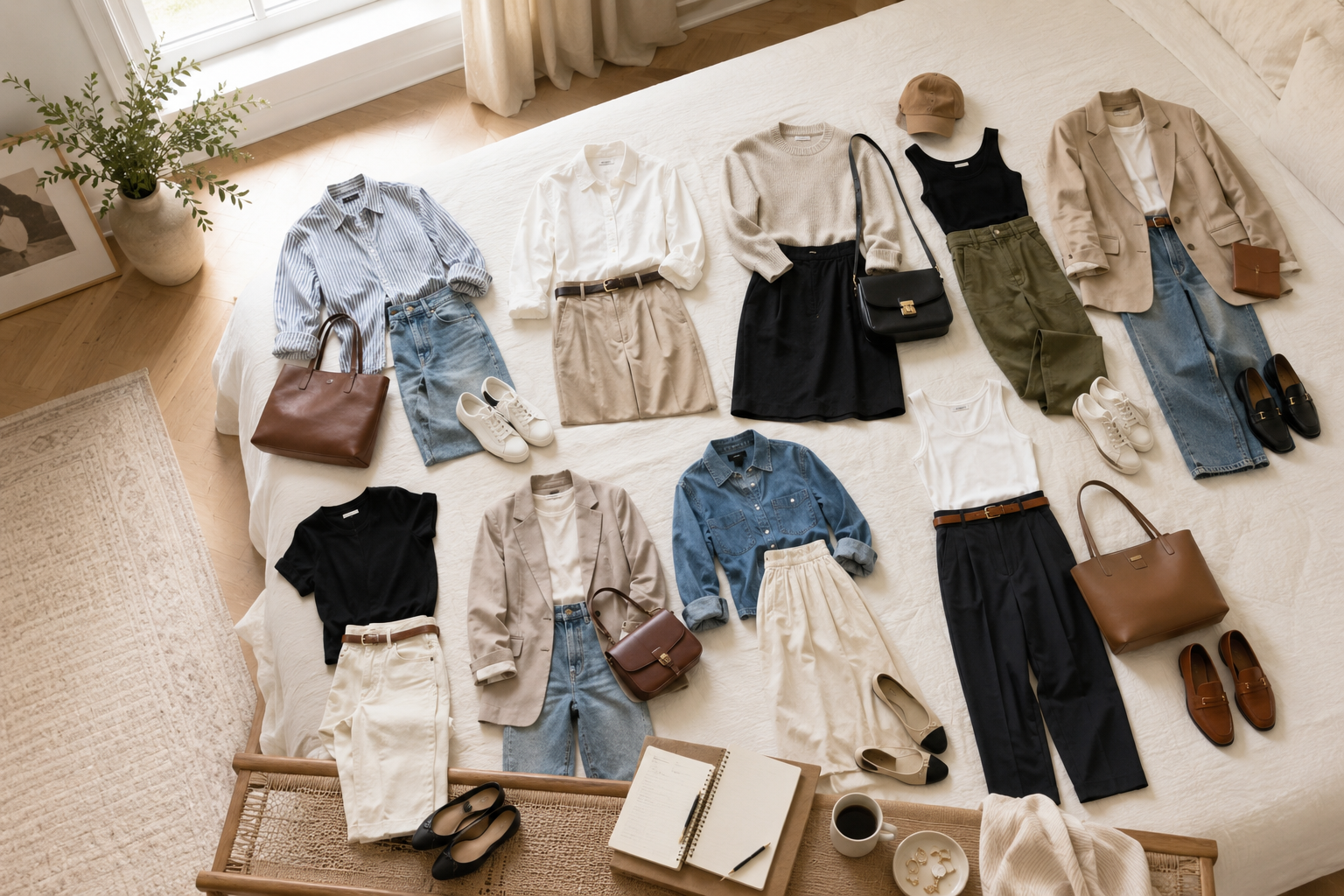
You can lay them out physically, try them on, photograph them, or save them digitally in OpenWardrobe.
The important part: build complete outfits, not vague ideas.
“Black pants with some top” is not an outfit. That is a cry for help from future you at 8:13 a.m.
A complete outfit includes:
- Top
- Bottom or dress
- Layer if needed
- Shoes
- Bag
- Accessories
- Weather or temperature adjustment if needed
Here is the 10-outfit framework.
Outfit 1: The polished work or meeting outfit
Build one outfit that makes you feel capable, comfortable, and pulled together.
Try:
- Trousers + sleeveless top + lightweight blazer + loafers
- Straight-leg jeans + button-down shirt + belt + flats
- Midi skirt + knit tank + cardigan + slingbacks
- Dress + blazer + simple jewelry + closed-toe flats
This should be an outfit you can wear when you need to be taken seriously but do not want to feel trapped in your clothes.
Ask yourself:
- Can I sit comfortably?
- Does it work on video and in person?
- Does it feel polished without trying too hard?
- Can I wear it in transitional weather?
Outfit 2: The second work outfit that does not feel like a repeat
Now build another work or meeting outfit with a different silhouette.
If Outfit 1 has trousers, try a skirt or dress. If Outfit 1 is structured, make Outfit 2 softer. If Outfit 1 is neutral, add a color.
Try:
- Wide-leg pants + fitted tee + cardigan + loafers
- Shirt dress + belt + flats
- Dark denim + blouse + blazer + ankle boots or flats
- Slip skirt + button-down shirt + clean sneakers or flats
The goal is to avoid relying on one “good outfit” until it gives notice.
Outfit 3: The casual errand outfit
This outfit should be easy, comfortable, and better than whatever you threw on while muttering “it’s just the grocery store.”
Try:
- Straight-leg jeans + tee + open button-down + sneakers
- Tailored shorts + tank + lightweight shirt + sandals
- Pull-on trousers + fitted tee + denim jacket + flats
- Cotton dress + sneakers + crossbody bag
This is the outfit for errands, appointments, school pickup, casual coffee, and being perceived by other humans when you did not emotionally consent but still want to look fine.
Outfit 4: The elevated casual outfit
This is one step above errands, but not full dinner or work.
Try:
- White jeans + striped shirt + brown belt + sandals
- Linen trousers + black tank + loafers
- Midi skirt + tee + denim jacket + sneakers
- Dark denim + sleeveless knit + flats + structured bag
This outfit should work for casual lunch, relaxed meetings, weekend plans, or days when you want to look like you made an effort without becoming an event.
Outfit 5: The dinner or social outfit
Build one outfit that works for casual dinners, drinks, date night, or seeing friends.
Try:
- Slip skirt + fitted tank + lightweight blazer + sandals
- Dark jeans + silk or satin top + flats or heels
- Dress + denim jacket + jewelry + sandals
- Wide-leg trousers + sleeveless blouse + statement earrings
Make sure the outfit works for the actual places you go.
If your dinners are mostly neighborhood restaurants, do not build an outfit for a rooftop in Milan unless you are, in fact, going to a rooftop in Milan. In which case, take us with you emotionally.
Outfit 6: The “I forgot I had plans” outfit
This is your emergency confidence outfit. It should be easy to put on and hard to mess up.
Try:
- Black dress + favorite shoes + simple jewelry
- White jeans + black top + leather sandals
- Dark denim + button-down shirt + belt
- Trousers + fitted knit + loafers
- Midi skirt + tank + cardigan
This outfit is for the day when your calendar surprises you, your brain refuses to participate, and you still need to leave the house looking intentional.
Outfit 7: The hot-to-cool transition outfit
Early fall often means warm afternoons, cooler mornings, cold indoor spaces, and weather that refuses to pick a lane.
Build one outfit with removable layers.
Try:
- Tank + lightweight trousers + button-down shirt + flats
- Summer dress + cardigan + sneakers
- Tee + midi skirt + denim jacket + sandals
- Sleeveless blouse + wide-leg pants + linen blazer
This outfit should handle temperature changes without making you carry half your closet around.
Outfit 8: The second transition outfit
Make this one different from Outfit 7.
If your first transition outfit uses pants, try a dress. If it uses a blazer, try a denim jacket or cardigan. If it is light-colored, try richer colors.
Try:
- Olive pants + white tee + denim shirt + sneakers
- Black tank dress + button-down shirt + sandals
- Cream trousers + navy tee + lightweight cardigan + loafers
- Denim skirt + striped top + jacket + flats
The best transition outfits use summer fabrics with slightly more fall-feeling colors or layers.
Outfit 9: The busy-day comfort outfit
This is for travel days, long errand days, school events, commuting, appointments, or any day with too many locations and not enough patience.
Try:
- Pull-on trousers + tee + cardigan + sneakers
- Soft jeans + button-down + crossbody bag + flats
- Cotton dress + denim jacket + sneakers
- Wide-leg pants + tank + lightweight sweater + sandals
This outfit should pass three tests:
- Can I walk in it?
- Can I sit in it?
- Can I wear it for eight hours without resenting every seam?
If not, it is not a busy-day outfit. It is a betrayal with buttons.
Outfit 10: The “new season” outfit
This outfit should make you feel like fall is coming, even if the weather is still being dramatic.
Use one or two early-fall elements:
- Darker color
- Denim
- Lightweight knit
- Loafers
- Structured bag
- Belt
- Jacket
- Longer pant
- Richer texture
Try:
- Cream jeans + chocolate tank + denim jacket + loafers
- Navy dress + tan belt + flats
- Black linen pants + white shirt + brown sandals
- Olive trousers + striped tee + structured tote
- Dark denim + sleeveless knit + ballet flats
This outfit gives you the feeling of seasonal change without forcing you into sweaters too early.
Step 5: Try everything on
This is the part people want to skip.
Do not skip it.
Outfits that look good in theory may not work on your actual body, in your actual mirror, with your actual shoes.
Try on each outfit and check:
- Does everything fit today?
- Can I sit, walk, and move?
- Does the shoe work with the hem?
- Do I need a belt?
- Is the top too sheer?
- Is the outfit too warm?
- Is the outfit too casual or too dressed up?
- Do I feel like myself?
If something is off, adjust it now. Future you deserves fewer surprises.
This is also where you may discover that the thing you thought you needed to buy is not the issue at all. Maybe you do not need new trousers. Maybe you need to hem the ones you own. Maybe you do not need another cardigan. Maybe you need a better bra under the top you keep avoiding.
Wardrobe clarity is not always glamorous. Sometimes it is just tailoring and undergarments doing heroic work.
Step 6: Photograph or save each outfit
Once an outfit works, save it.
Do not trust yourself to remember it. You are a busy person with passwords, appointments, grocery lists, and at least one mystery charger in a drawer.
Take a photo or save the outfit in OpenWardrobe.
For each outfit, note:
- Occasion
- Weather
- Season
- Shoes
- Layer
- Why it works
- Any missing item or alteration needed
This creates an outfit bank you can return to when you are tired, rushed, uninspired, or dangerously close to online shopping because a newsletter said “fall essentials.”
Step 7: Identify your real wardrobe gaps
After you build 10 outfits, look at what was hard.
Were you missing:
- Comfortable flats?
- A good belt?
- A lightweight jacket?
- Work-appropriate tops?
- Non-denim pants?
- A polished bag?
- Transitional shoes?
- A cardigan that does not feel sad?
- A white tee that is not transparent?
- A dress that can be layered?
- A pair of trousers that actually fits?
Now you have useful shopping information.
A real wardrobe gap appears repeatedly across outfits. It is not one random item you want because it looked good on someone standing in a doorway in Copenhagen.
For example:
- If five outfits would improve with brown loafers, that may be a real gap.
- If one outfit needs a sequined vest, maybe sit with that for a minute.
- If every work outfit feels too casual, you may need one structured layer.
- If every outfit depends on the same pair of jeans, you may need a second reliable bottom.
- If you have tops but no shoes that make them feel current, start with shoes.
Shop for the gap, not the mood.
What to buy after the reset, if anything
After building your 10 outfits, you may realize you do need something. Good. Now you can shop with a plan.
Useful fall connector pieces often include:
- Leather belt
- Loafers or ballet flats
- Lightweight blazer
- Denim jacket
- Cotton cardigan
- White or cream button-down
- Better tee or tank
- Straight-leg jeans
- Lightweight trousers
- Structured tote
- Crossbody bag
- Thin sweater
- Transitional dress
- Closed-toe flats
Before buying, ask:
- Does this complete at least three outfits?
- Can I wear it for my actual routine?
- Does it work with my existing colors?
- Is it comfortable enough to wear often?
- Am I solving a problem or feeding a mood?
- Would I still want this if it were not labeled “new fall arrival”?
If the item cannot pass the test, it may not be a wardrobe gap. It may be seasonal marketing in a cute little blazer.
Back-to-routine outfit formulas
Use these formulas to build your 10 outfits faster.
Formula 1: The polished work formula
Wear:
- Trousers
- Sleeveless top or tee
- Lightweight blazer or cardigan
- Loafers or flats
- Structured bag
Why it works: it looks pulled together but can handle transitional weather.
Formula 2: The casual routine formula
Wear:
- Jeans or lightweight pants
- Tee or tank
- Button-down shirt worn open
- Sneakers or sandals
- Crossbody bag
Why it works: comfortable, easy, but still styled.
Formula 3: The dress reset formula
Wear:
- Summer dress
- Belt or button-down layer
- Flats, sneakers, or sandals
- Simple jewelry
Why it works: it extends summer dresses into your back-to-routine wardrobe.
Formula 4: The early fall color formula
Wear:
- Light base piece
- One richer color like olive, navy, chocolate, burgundy, or black
- Brown or black accessories
Why it works: it feels seasonal without being too warm.
Formula 5: The busy-day formula
Wear:
- Pull-on trousers or comfortable jeans
- Soft tee or knit
- Light layer
- Walkable shoes
- Hands-free bag
Why it works: it is practical without giving up.
Formula 6: The dinner-after-a-long-day formula
Wear:
- Dark denim or trousers
- Better top
- Jewelry
- Flats, sandals, or low heels
- Small bag
Why it works: you can change the mood without changing your whole outfit.
Formula 7: The indoor-outdoor formula
Wear:
- Breathable base
- Removable layer
- Comfortable shoes
- Practical bag
Why it works: it handles warm days, cold offices, and unpredictable indoor temperatures.
What not to do during a back-to-routine wardrobe reset
Do not buy before you build outfits
That is how you end up with “great pieces” that do not work together.
Do not build outfits for a life you do not have
Your wardrobe should support your real schedule. Aspirational is fine. Fictional is expensive.
Do not keep uncomfortable clothes in your main outfit rotation
If it pinches, rides up, gaps, slides, or requires constant monitoring, it is not helping your routine.
Do not ignore shoes
Shoes often determine whether an outfit works. Many wardrobe gaps are actually shoe gaps in disguise.
Do not assume everything has to feel new
Sometimes an old piece feels new when styled with a different shoe, belt, layer, or color.
Do not create outfits only for perfect weather
Build for real days: heat, AC, errands, sitting, walking, commuting, and the possibility that your afternoon may get weird.
How to use OpenWardrobe for your back-to-routine reset
OpenWardrobe makes this easier because you can build outfits from the clothes you already own instead of trying to remember everything in your closet.
Try this reset inside OpenWardrobe:
- Open your wardrobe and filter by pieces you wear in late summer and early fall.
- Start with your most-worn bottoms: jeans, trousers, skirts, shorts, or dresses.
- Build 10 complete outfits for your real routine.
- Save each outfit by occasion, weather, and season.
- Use the calendar to plan when you will wear them.
- Track what you actually wear.
- Notice which pieces keep getting used and which keep getting skipped.
- Create a short shopping list only after you see the real gaps.
You can also use your outfit history to avoid buying duplicates. If you already own three lightweight white shirts but keep reaching for none of them, the answer is probably not a fourth lightweight white shirt. The answer is figuring out why the existing ones are not working.
OpenWardrobe helps you turn “I have nothing to wear” into a clearer question: “What outfit do I need for the life I’m actually dressing for?”
Much more useful. Far less dramatic. Though we do respect a small amount of drama in the mirror.
10-outfit checklist
Use this checklist before shopping for fall:
- One polished work or meeting outfit
- One second work outfit with a different silhouette
- One casual errand outfit
- One elevated casual outfit
- One dinner or social outfit
- One emergency confidence outfit
- One hot-to-cool transition outfit
- One second transition outfit
- One busy-day comfort outfit
- One “new season” outfit
Then ask:
- Did I try each outfit on?
- Did I choose shoes for each outfit?
- Did I add layers where needed?
- Did I save or photograph each outfit?
- Did I identify actual wardrobe gaps?
- Did I make a shopping list based on outfits, not impulse?
If you can check those boxes, you are ready to shop—if you still need to.
FAQ: Back-to-routine wardrobe reset
What is a wardrobe reset?
A wardrobe reset is a quick review of your clothes, outfits, and routine so your wardrobe works better for your current life. It is smaller than a full closet cleanout and more practical than simply buying new clothes.
How many outfits should I build before shopping?
Start with 10 complete outfits. That is enough to cover common weekly situations and reveal real wardrobe gaps without becoming overwhelming.
Should I put away summer clothes before fall?
Not all at once. Keep the summer pieces that still work in warm weather and layer well into early fall, such as dresses, tanks, button-down shirts, lightweight trousers, and skirts.
What should I buy first for fall?
Buy the item that completes the most outfits. Common useful pieces include loafers, a belt, a lightweight jacket, a cardigan, trousers, or a structured bag. Do not buy based only on trend appeal.
How do I make my wardrobe feel new without buying clothes?
Change the styling. Try different shoes, belts, layers, color combinations, and proportions. Build outfits around pieces you have not worn recently.
What if I still feel like I have nothing to wear?
Look for the pattern. Are you missing comfortable shoes? Work tops? Better basics? Transitional layers? Clothes that fit your current body and routine? “Nothing to wear” usually means your wardrobe is not organized into usable outfits yet.
Final thought: shop from clarity, not panic
The back-to-routine season can make anyone feel like they need a wardrobe overhaul.
But before you start buying fall clothes, build 10 outfits from what you already own.
You may discover that your wardrobe has more potential than you thought. You may find old favorites, new combinations, and pieces that are ready for another season. You may also find real gaps, which is useful.
That is the point.
Do not shop because your routine changed and your closet suddenly feels loud.
Shop after you know what you actually need.
Build the outfits first. Let your wardrobe show you the gaps. Then buy with a plan.
Future you, standing in front of the closet on a busy morning, will be very grateful.